The Consolidator’s Playbook: Why 2026 is Seeing a Surge in UK SME Acquisitions
Why "Buy-and-Build" Platforms are Targeting the £1m–£30m SME Market and What it Means for Your Exit Value

Introduction
John had built his regional professional services firm over two decades. With £3m in revenue, 15 staff, and a loyal client base across the South West, he assumed his eventual exit would involve a local successor or perhaps a friendly merger with a neighbouring firm. However, in early-March 2026, he received three unsolicited approaches within ten days - all from national platforms backed by institutional capital. John wasn't just a business owner anymore; he was a "strategic bolt-on" in a massive, nationwide consolidation play.
The first quarter of 2026 has marked a definitive shift in the UK mid-market. While headline-grabbing multi-billion pound deals often dominate the financial press, the real story is happening in the £1m–£30m revenue bracket. Data from the first four months of 2026 reveals a significant acceleration in "buy-and-build" activity. Professional buyers - often referred to as 'consolidators' - are systematically hunting for quality UK SMEs to fold into larger, more valuable platforms.
For the UK business owner, this environment creates a unique window of opportunity. Liquidity is high, and acquisition appetite is robust. However, it also introduces a sophisticated type of buyer who follows a very specific playbook. This playbook is designed to maximise the buyer’s eventual return, often by ruthlessly identifying and pricing the risks within your business. Understanding this logic is the difference between achieving a life-changing, high-certainty exit and a deal that leaves millions on the table or ties you into an agonising multi-year earn-out.
The Rise of the Professional Acquirer
March 2026 saw record-breaking activity in sectors traditionally seen as fragmented, such as wealth management, specialized engineering, and professional services. Large platforms, supported by significant private equity "dry powder," are no longer satisfied waiting for the biggest players to come to market. Instead, they are moving "upstream" to acquire firms in the £1m–£30m revenue range, and we are also seeing more deals in the £2-£10m range.
These consolidators aren't buying your business just for its historical profit. They are buying "units of production" - your client relationships, your specialized talent, and your geographic footprint - to plug into a much larger machine.
The "Multiple Arbitrage" Trap
Why is this revenue range so attractive to these buyers? The answer lies in "multiple arbitrage." A standalone business with £2m in revenue might be valued at a 4-5x multiple of its earnings. However, a consolidated group with £50m in revenue might be valued at 10x. By buying you at 5x and instantly revaluing your earnings as part of their 10x group, the consolidator has doubled the value of your business on paper the moment the ink is dry. As a seller, your goal is to capture as much of that "uplift" as possible, rather than letting the buyer keep it all.
Action step: Research your sector’s "consolidators." If three or more national firms are actively acquiring in your niche, you are in a high-demand sector where competitive tension can significantly drive up your price.
Understanding the Consolidator’s Valuation Logic: Revenue over EBITDA
The most significant takeaway from recent deals, including several high-profile service-sector acquisitions in late March, is the shift in how value is calculated. Professional buyers in 2026 are looking past simple EBITDA (Earnings Before Interest, Taxes, Depreciation, and Amortisation) and focusing intensely on the character of your revenue.
1. The "Recurring Revenue" Premium
In 2026, the market is tiered. We are seeing a massive valuation gap between businesses with "transactional" revenue (project-based) and those with "fee-based" recurring revenue (contractual). Consolidators are paying significant premiums - often 20-30% above the sector average - for firms that can demonstrate that 80% of next year's revenue is already contractually committed.
If your business relies on "hunting" for new projects every month, you are viewed as high-risk. If your business "farms" long-term client relationships through subscriptions or retainers, you are a "platform-ready" asset.
2. The "Client Concentration" Discount
During the due diligence of two mid-market tech firms recently, deals were reportedly repriced downward because of hidden customer concentration. A consolidator thrives on stability. If 40% of your revenue comes from two clients, you represent a single point of failure. Professional buyers will either lower the upfront price or structure a much heavier "earn-out" to protect themselves against a client leaving post-acquisition.
Action step: Conduct a "revenue audit" of your top ten clients. If any single client accounts for more than 15% of your turnover, your immediate priority should be diversifying your base to protect your eventual exit valuation.
The "Owner-Dependency" Integration Discount
In the lower mid-market, the most common deal-killer is the founder. Consolidators are looking for a "business," not a "job." If you, the owner, are the primary salesperson, the chief technical officer, and the only person with the relationships to satisfy your top ten clients, your business is technically worth very little to a national platform.
The Exit Maturity Test
Buyers in the current market are applying an informal "Exit Maturity Test." They look at your management team and ask: "Could the founder leave on the day of completion without the business shrinking?"
If the answer is no, the buyer will apply an "integration discount." This typically takes the form of a lower multiple and a mandatory, lengthy handover period where you are an employee, not a boss. To avoid this, you must spend the 18–24 months before an exit "institutionalising" your relationships.
Clients must belong to the brand, not the person.
Documenting the "Secret Sauce"
We often find that founders have "intuitive" processes. Consolidators, however, require "documented" processes. If your operations are in people’s heads rather than in a manual or a robust CRM/ERP system, you are seen as an integration risk. Clean, transferable data is a major value driver in 2026.
Action step: Identify the three most critical tasks you perform in the business today. Appoint a deputy for each and document the workflow. If you aren't "redundant" by the time you're ready to sell, you're not exit-ready.
The 50/50 Structural Trend: Guarding Your Cash
One of the most striking patterns in recent deal structures is the "de-risking" shift. Across the wealth management and specialized agency sectors, we are seeing "50/50" offers becoming the standard. This means 50% of the price is paid in cash at completion, with the remaining 50% deferred as an "earn-out" over 2 to 3 years.
Why Consolidators Love Earn-outs
Earn-outs are a safety net for the buyer. They ensure the owner stays motivated to integrate the business and that the revenue doesn't "walk out the door." However, for a founder, an earn-out is often a source of immense stress. You are working for someone else, often using their systems and their brand, to hit targets that determine half of your life's work.
How to Push Back
To achieve a "70/30" or "80/20" structure - which used to be more common - you must prove that the business is a "turnkey bolt-on." The more evidence you have that the revenue is stable, the management is independent, and the data is clean, the more leverage you have to demand "cash at completion."
Action step: Professional buyers look for "points of friction." Pre-emptively fix your employment contracts, ensure your IP is legally protected, and cleanse your data room before you engage in negotiations.
The Perils of the "Unsolicited Approach"
It is flattering to receive a letter from a national player saying they’ve "identified your business as a leader in the region." But remember: their goal is to buy you "off-market" without you talking to any other buyers.
If you negotiate with only one consolidator, you have zero leverage. They know it, and they will use due diligence to "chip" away at the price. The most successful exits we support at ESS are those that create "competitive tension." Even if you only want to sell to a specific platform, having a credible second offer on the table can add 10-15% to your headline price and significantly improve the cash-on-completion terms.
Conclusion: Moving from "Target" to "Partner"
The consolidation wave moving through the UK lower to mid-market in 2026 represents a unique opportunity for founders in the £1m–£30m revenue bracket. The capital is there, and the strategic rationale is clear. However, the market is no longer a "buyer beware" environment - it is a "seller prepare" environment.
Professional acquirers are disciplined. They are looking for businesses that act like platforms, not local shops. By focusing on revenue quality, management depth, and operational clean-ups at least 24 months before the deal, you change the dynamic. You are no longer a "target" to be acquired and integrated; you are a prized partner with the leverage to dictate terms.
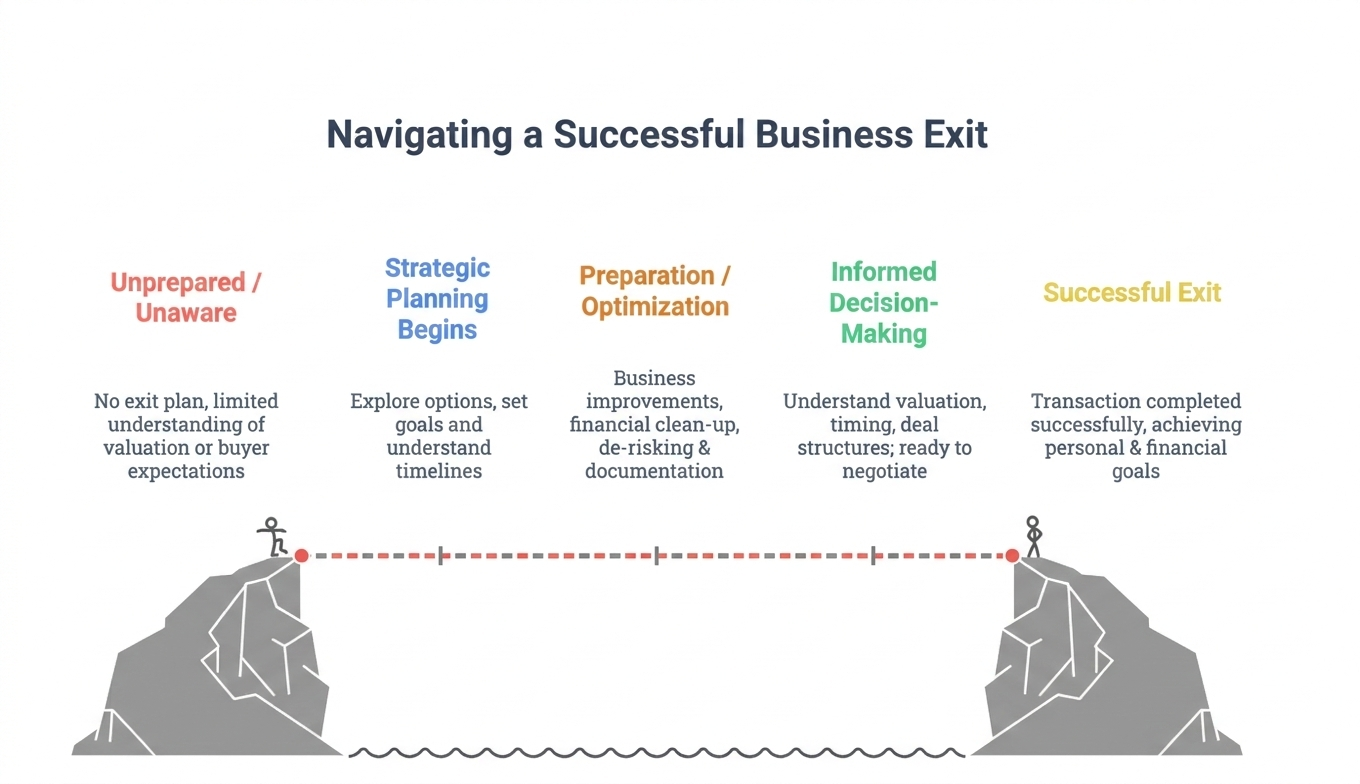
The ultimate goal of exit planning isn't just to sell - it's to be ready to sell. Readiness builds optionality. It means that when that unsolicited approach lands on your desk, you can respond from a position of strength, knowing exactly what your business is worth and exactly how to protect that value.
--------------------------------------------------------------------------------------------------------------------------------------------------------------------
About Exit Strategy & Solutions
Exit Strategy & Solutions is a specialist advisory firm helping UK SME owners (typically £1-30M revenue) maximise business value and achieve successful exits. We provide strategic exit planning, readiness assessment, business valuation, founder decision support, and transaction support across all sectors.
Our approach combines deep market intelligence, strategic positioning expertise, and practical transaction experience to help owners achieve premium valuations and successful outcomes.
Ready to explore your exit options?
Take our Exit Readiness Calculator at www.exitstrategyandsolutions.com/exit-readiness-calculator to assess your business's exit readiness and identify opportunities to maximise value.
Contact us:
Email: enquiry@exitstrategyandsolutions.com
Phone: 0330 043 4689
Website: www.exitstrategyandsolutions.com
Disclaimer
This article is provided for informational purposes only and does not constitute financial, legal, tax, or investment advice. Every business situation is unique, and owners should consult with qualified professional advisors before making exit planning or transaction decisions.
Examples cited are based on composite scenarios created for illustrative purposes. Actual transaction terms, valuations, and outcomes vary based on specific circumstances.
Exit Strategy & Solutions is not responsible for decisions made based on information in this article. Professional advice tailored to your specific situation is essential for successful exit planning and execution.
Copyright © Exit Strategy & Solutions 2026. All rights reserved.