
The 3‑5 Year Exit Blueprint: Add 20‑50% to Your Valuation with Early Preparation
Why the Best Time to Plan Your Exit Was Five Years Ago - and Why the Second-Best Time Is Right Now
Introduction
When Sarah Brown sold her Manchester-based logistics software company last October, the final transaction value left her corporate finance advisor genuinely surprised. The business had transacted at 8.2x EBITDA - well above the sector average of 5.5-6x for comparable businesses. The deal closed in just fourteen weeks with minimal price adjustments during due diligence.
What made the difference? Sarah hadn't started preparing for her exit six months before going to market. She'd started four years earlier.
"Looking back, those four years of preparation were the best investment I ever made in the business," Sarah told me. "Not because I was obsessed with selling - I genuinely thought I might keep going for another decade. But building the business as if it could sell at any moment made it dramatically more valuable and, honestly, more enjoyable to run."
Sarah's experience isn't unusual. It reflects a pattern that corporate finance advisors and transaction data consistently confirm: businesses that undergo systematic 3-5 year exit preparation typically achieve valuations 20-50% higher than comparable businesses brought to market without such preparation.
For UK SME owners with revenues between £1-30 million, this valuation premium represents the difference between a good outcome and a transformative one. If your business might be worth £7-8 million with a rushed exit, that same business could be worth £10-12 million with proper preparation. That's not marginal - it's life-changing.
Here's what a strategic, multi-year exit preparation process looks like - and why the Q1 2026 market conditions make starting now particularly compelling.
The Valuation Premium: What the Data Shows
The claim that preparation adds 20-50% to business value isn't speculation - it's consistently demonstrated in transaction outcomes.
Why prepared businesses command premium valuations:
- Reduced buyer risk: Every unknown in a business represents risk, and buyers discount for risk. Prepared businesses with clean financials, documented processes, and transparent operations present fewer unknowns.
- Competitive tension: Well-prepared businesses attract more qualified buyers. More buyers mean competitive bidding. Competitive bidding drives up prices. In 2025, average bid premiums in UK M&A reached approximately 46% - but only for businesses positioned to attract multiple serious bidders.
- Faster transactions: Prepared businesses close faster. Faster closings mean less deal fatigue, fewer price adjustments, and lower risk of market conditions shifting. Buyers will pay a premium for certainty.
- Demonstrated transferability: A business that clearly operates without founder dependency is worth more than one where the owner is the business. Preparation proves transferability.
The market conditions in early 2026 amplify these dynamics. Private equity funds hold an estimated £178 billion in dry powder - capital committed but not yet deployed. This creates significant pressure to execute deals, with a particular appetite for SMEs demonstrating predictable revenues and clear growth opportunities.
The pattern: Buyers don't pay for past effort; they pay for the prospect of future, reliable profits. Preparation makes those future profits seem more secure - and that security commands a premium.
The Year-by-Year Exit Preparation Roadmap
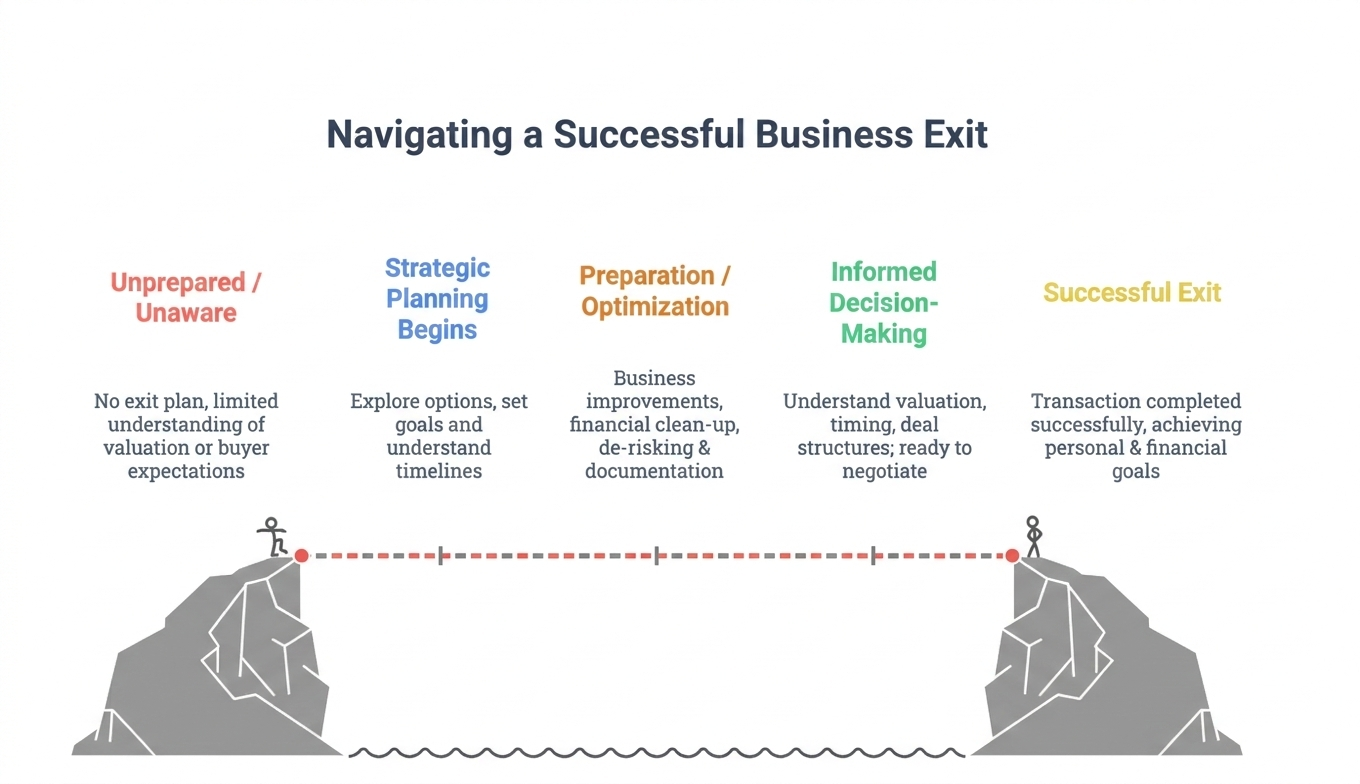
Effective exit preparation isn't a frantic sprint before going to market - it's a deliberate, phased process that builds value systematically while keeping your options open.
Years 5-3: Foundation Building
This early phase focuses on establishing the fundamentals that make a business transferable and attractive.
Financial excellence priorities:
- Implement robust financial systems: If you're still running your accounts on spreadsheets or a basic package, upgrade to systems that can produce management accounts that would satisfy a sophisticated buyer's due diligence team.
- Establish consistent reporting rhythms: Monthly management accounts, quarterly board reviews, annual audits (even if not legally required). This creates the financial track record buyers will scrutinise.
- Clean up personal expenses: That company car, the office renovation that's really your wife's interior design business, the "entertaining" that's actually family dinners - get these out of the business now. Buyers will find them, and they'll discount accordingly.
Operational independence priorities:
- Document key processes: Start creating the operations manual that proves your business can run without you. Focus first on the processes that would cause immediate problems if a key person left.
- Build your management team: Begin identifying and developing the people who could run this business after you're gone. This doesn't happen overnight - it takes years of hiring, training, and trust-building.
- Reduce key person dependency: If you're the only one who can land major clients or solve technical problems, that's a significant valuation discount waiting to happen.
Action step: Commission an independent business valuation now - not because you're selling, but because understanding your current value and its drivers will focus your preparation efforts where they'll have the greatest impact.
Years 3-1: Value Acceleration
With foundations in place, this phase focuses on accelerating value creation and preparing for the transaction process.
Revenue quality improvements:
- Increase recurring revenue: Buyers pay premium multiples for predictable revenue. Converting one-off projects to retainers, implementing subscription models, or building long-term contracts all improve revenue quality.
- Diversify your customer base: If your top three customers represent more than 40% of revenue, that's a concentration risk that buyers will discount. This takes time to fix - start now.
- Improve gross margins: Examine pricing, supplier relationships, and operational efficiency. Every percentage point of margin improvement flows directly to your valuation.
Strategic positioning priorities:
- Build strategic relationships: As recent market activity demonstrats, businesses with existing strategic partnerships or relationships with potential acquirers often achieve premium valuations. Start building these relationships before you're selling.
- Protect intellectual property: Register trademarks, document proprietary processes, and ensure your IP is properly owned by the company - not trapped in founders' heads or informal arrangements.
- Address competitive vulnerabilities: What could a well-funded competitor do to damage your business? Shore up these vulnerabilities before buyers identify them as risks.
Action step: Create a "buyer's eye view" assessment by listing every question a sceptical acquirer might ask about your business. Then systematically address each one over the next 24 months.
The Final 12 Months: Transaction Readiness
The final year before going to market focuses on transaction-specific preparation.
Due diligence preparation:
- Assemble your data room: Create a comprehensive virtual data room with all documents a buyer will request: financials, contracts, employee records, IP documentation, compliance certifications, and corporate records.
- Conduct legal housekeeping: Update shareholder agreements, ensure contracts are properly executed, resolve any outstanding disputes, and confirm all regulatory filings are current.
- Prepare for representations and warranties: Understand what warranties you'll likely be asked to give in a sale agreement and ensure you can give them honestly. Undisclosed issues discovered during due diligence kill deals or slash prices.
Advisory team assembly:
- Engage your deal team: Corporate finance advisor, M&A lawyer, accountant, and tax specialist should be selected and briefed. These relationships take time to develop - don't wait until you're mid-transaction.
- Brief your board: If you have non-executive directors or advisory board members, engage them in exit planning. Their networks and experience can be invaluable during the process.
Action step: Complete a "sell-side due diligence" process 6-9 months before going to market - having your own advisors identify issues before buyers do gives you time to address them without deal pressure.
The Four Pillars of Exit Readiness
Effective exit preparation rests on four interconnected pillars. Weakness in any one can undermine the others.
Pillar 1: Financial Excellence
This is the foundation everything else builds upon. Buyers will scrutinise your financials intensively, and any weakness here undermines confidence in everything else you claim about your business.
Key elements:
- Three years of clean, consistent accounts: Prepared to audit standard, even if not formally audited
- Clear revenue recognition policies: Especially important for businesses with complex contracts or recurring revenue models
- Normalised EBITDA presentation: Clearly documented add-backs that any reasonable buyer would accept
- Working capital analysis: Understanding your cash conversion cycle and working capital requirements
Pillar 2: Operational Independence
Can this business thrive without its current owner? If the answer isn't a confident "yes," you have work to do.
Key elements:
- Documented systems and processes: The business runs on systems, not on founder knowledge
- Capable management team: People who can make decisions without escalating everything to the owner
- Proven customer relationships: Clients who are loyal to the business, not just to the founder
- Supplier relationships: Contracts and relationships that will survive ownership change
Pillar 3: Legal and Compliance Hygiene
Legal issues discovered during due diligence don't just delay transactions - they destroy value and trust.
Key elements:
- Clean corporate records: Formation documents, board minutes, shareholder resolutions all properly maintained
- Employment compliance: Contracts, handbooks, pension auto-enrolment, HMRC compliance all in order
- Contract hygiene: Customer and supplier contracts properly executed with clear terms
- Regulatory compliance: Industry-specific requirements documented and current
Pillar 4: Strategic Positioning
Beyond the fundamentals, how is your business positioned to attract premium buyers and support premium valuations?
Key elements:
- Clear growth narrative: A compelling story about future potential that sophisticated buyers find credible
- Competitive differentiation: Understanding of what makes you valuable and defensible
- Market positioning: Clarity on where you fit in your market and why that position is attractive
- Strategic relationships: Connections that could become partnerships, investments, or acquisitions
Common Pitfalls of Last-Minute Exits
Understanding what goes wrong in rushed exits helps illustrate why preparation matters.
The discovery discount: Issues discovered during due diligence - whether financial adjustments, customer concentration, key person dependency, or legal problems - typically result in 15-25% price reductions. With preparation, these issues are either resolved or disclosed upfront and priced into the initial offer.
The single-buyer trap: Without time to run a proper process, sellers often end up negotiating with a single buyer. Single-buyer situations eliminate competitive tension, giving the buyer all the leverage. Prepared businesses attract multiple qualified buyers, creating the competitive dynamics that drive premium valuations.
The exhaustion effect: Rushed exits are exhausting. Running a business while simultaneously preparing for and executing a transaction wears owners down. Exhausted sellers accept worse terms just to be done. Prepared sellers manage the process from a position of strength.
The timing trap: Owners who haven't prepared often wait until they're burnt out, health issues arise, or market conditions deteriorate. This forces them to sell when they're weak rather than when they're strong. Preparation creates optionality - you can sell when conditions are right, not when circumstances force you.
The Q1 2026 Market Context: Why Starting Now Matters
Several factors make Q1 2026 a particularly important time to begin or accelerate exit preparation.
BADR rate changes: Business Asset Disposal Relief currently provides a 14% CGT rate on the first £1 million of qualifying gains. From April 2026, this rate increases to 18%. For businesses planning exits in the next 18-36 months, this creates meaningful tax planning considerations.
PE deployment pressure: With £178 billion in dry powder and a backlog of deferred exits from 2025, private equity activity in 2026 is expected to be robust. Businesses positioned to meet PE acquisition criteria - predictable revenues, scalable models, capable management teams - will find receptive buyers.
Interest rate environment: With the Bank of England base rate at 3.75% and expectations of further moderation, borrowing costs for acquisitions are improving. This supports buyer capacity and, ultimately, valuations.
Market stability: The clarity provided by the Autumn Budget 2025 has reduced the policy uncertainty that depressed market activity in 2024-2025. This stability encourages both buyers and sellers to engage with more confidence.
Action step: If you're considering an exit within the next 3-5 years, schedule a strategic review with your advisors in Q1 2026 to assess your readiness and create a preparation timeline aligned with current market conditions.
Your 90-Day Action Plan
If the case for multi-year exit preparation resonates, here's how to begin:
Days 1-30: Assessment
- Commission an independent business valuation or engage an exit strategy advisor for an indicative assessment
- Conduct a "buyer's eye view" assessment identifying weaknesses and unknowns
- Review your financial reporting and identify gaps in quality or consistency
- Assess your management team's capability to operate without you
Days 31-60: Planning
- Create a 3-year exit preparation roadmap with specific milestones
- Prioritise the highest-impact preparation activities
- Begin conversations with potential advisory team members
- Address the most time-sensitive issues identified in your assessment
Days 61-90: Foundation Building
- Implement improvements to financial reporting and controls
- Begin documenting key operational processes
- Initiate management development or hiring plans
- Start building relationships with potential strategic partners or advisors
Conclusion: The Exit You Prepare For
Sarah Brown's experience isn't remarkable because she achieved an exceptional outcome - it's remarkable because she did the work that made an exceptional outcome predictable. While her competitors rushed to market with unprepared businesses and accepted whatever buyers offered, she systematically built a business that sophisticated buyers competed to acquire.
The 20-50% valuation premium from exit preparation isn't a guarantee - it's an opportunity. The businesses that capture it are the ones whose owners recognise that exit planning isn't about preparing to sell; it's about building a more valuable, more resilient, more transferable business.
Whether you sell in three years or thirty, whether you sell to private equity, a strategic acquirer, or your management team; the preparation process makes your business better. And if you do eventually sell, that preparation will be the best investment you ever made.
The question isn't whether to prepare for exit. The question is: what's the cost of waiting another year to start?
--------------------------------------------------------------------------------------------------------------------------------------
About Exit Strategy & Solutions
Exit Strategy & Solutions is a specialist advisory firm helping UK SME owners (typically £1-30M revenue) maximise business value and achieve successful exits. We provide strategic exit planning, readiness assessment, business valuation, founder decision support, and transaction support across all sectors.
Our approach combines deep market intelligence, strategic positioning expertise, and practical transaction experience to help owners achieve premium valuations and successful outcomes.
Ready to explore your exit options?
Take our Exit Readiness Calculator at www.exitstrategyandsolutions.com/exit-readiness-calculator to assess your business's exit readiness and identify opportunities to maximise value.
Contact us:
Email: enquiry@exitstrategyandsolutions.com
Phone: 0330 043 4689
Website: www.exitstrategyandsolutions.com
Disclaimer
This article is provided for informational purposes only and does not constitute financial, legal, tax, or investment advice. Every business situation is unique, and owners should consult with qualified professional advisors before making exit planning or transaction decisions.
Examples cited are based on composite scenarios created for illustrative purposes. Actual transaction terms, valuations, and outcomes vary based on specific circumstances.
Exit Strategy & Solutions is not responsible for decisions made based on information in this article. Professional advice tailored to your specific situation is essential for successful exit planning and execution.
Copyright © Exit Strategy & Solutions 2026. All rights reserved.