What Your Client Needs Before the Deal - and Why it Matters to You
How accountants, solicitors and CF advisers can help their clients arrive at the deal table ready — and why it matters more than most realise

Introduction
James had been a client of his accountancy firm for eleven years. Good relationship, clean books, reliable. When he called to say he'd had an approach from a trade buyer and wanted to move quickly, his accountant was the first person he rang.
Within a week, it was clear the business wasn't ready. Customer concentration was a major issue. No management accounts for the current year. Three key contracts on verbal terms. And James — a genuinely talented operator — was the business in every meaningful sense. The buyer's advisers spotted all of it within a fortnight of diligence starting. The deal completed, eventually, at a significant discount to the original offer.
It's a familiar story. And it's rarely the adviser's fault.
The gap nobody talks about
For accountants, solicitors, and CF advisers working with owner-managed businesses, this scenario is more common than it should be. A client arrives at the point of transaction without the groundwork in place. Management accounts are inconsistent. Contracts are undocumented. The business runs through the owner's relationships, knowledge, and goodwill — none of which transfers easily to a buyer.
The result is predictable: diligence takes longer, buyers get nervous, price chips happen, and deals fall over. Sometimes the client blames the process. Sometimes they blame the adviser. Either way, a good outcome becomes much harder to deliver.
The gap isn't a failure of professional advice. It's a timing problem. Owners reach their advisers at the point of transaction, when the window for meaningful preparation has already closed.
What "not ready" actually looks like
Most advisers will recognise these immediately:
Inconsistent financials
Three years of accounts that tell three different stories, with add-backs that haven't been documented or normalised. Buyers will reconstruct EBITDA themselves — and their version is rarely more favourable than yours.
Key person dependency
The owner is the business. Relationships, knowledge, and decision-making all sit with one individual, with no clear succession below them. Buyers price this risk heavily.
Customer concentration
One or two clients represent 40–60% of revenue. Buyers will discount for this or walk away entirely. It takes 12–24 months to meaningfully diversify a customer base — time that simply isn't available mid-transaction.
Undocumented IP and contracts
Verbal agreements, informal arrangements, and unregistered intellectual property look fine from the inside but create serious diligence flags from the outside. Solicitors in particular will recognise how quickly this unravels under scrutiny.
Unrealistic valuation expectations
The owner has a number in mind, often based on a conversation at a networking event or a multiple they read online. It bears little relation to what the market will actually pay — and resetting expectations mid-process is one of the most difficult conversations in any transaction.
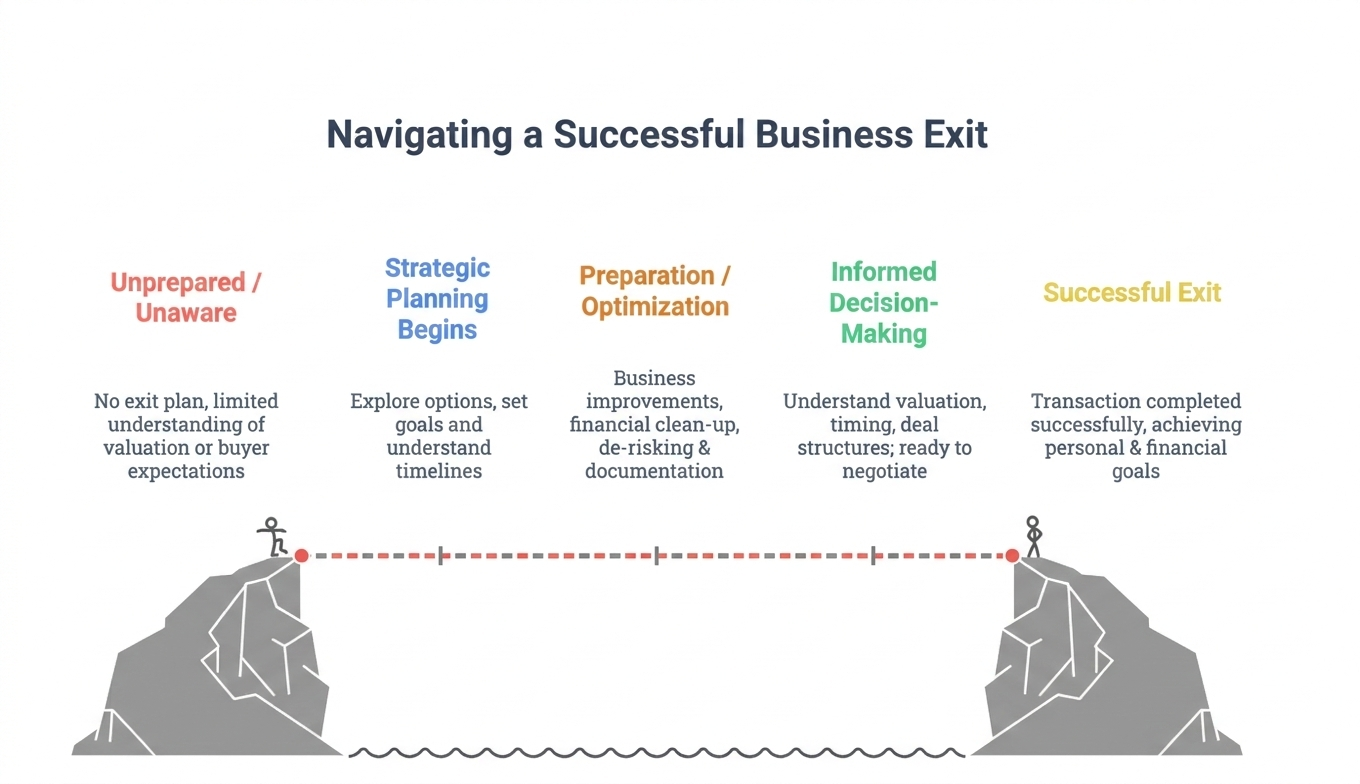
None of these are insurmountable. But they take time to address — typically 12 to 24 months of structured preparation. By the time a client is sitting across from a buyer, that time has gone.
Where ESS fits — and where we don't
Our role
Exit Strategy & Solutions works mainly upstream of the transaction. We are not a corporate finance firm, a law firm, or an accountancy practice. We do not compete with any of them.
What we do is prepare owner-managed businesses for exit before they reach the point of transaction — working with owners 12 to 24 months ahead of a sale to identify and address the issues that create friction, reduce value, or derail deals.
Your role
By the time a client reaches their CF adviser, solicitor, or accountant with a proposed deal, the groundwork is done. Clean financials, documented processes, realistic expectations, and a clear narrative for buyers. Diligence is smoother. Timelines are shorter. Outcomes are better for your clients.
How it works in practice
We are deliberately positioned as an upstream partner. We introduce clients to the right professional advisers at the right time, and we generally step back when transaction work begins, other than providing the high-touch, strategic and emotional support to clients. For professional firms, a prepared client is a better client — fewer surprises, fewer delays, and a higher likelihood of a successful completion.
What a prepared client looks like
For the transaction
When an owner has worked through a structured exit readiness process, they arrive with:
- Normalised, well-documented financials with a clear EBITDA story
- A management team that can operate independently of the founder
- Contracts, IP, and key agreements properly documented and transferable
- A realistic view of valuation, based on comparable transactions and market evidence
- A clear sense of what they want from a deal — price, structure, timeline, legacy
For your practice
This translates directly into a more efficient, less stressful transaction process. Less time spent firefighting diligence issues. More time spent on the work that actually requires your expertise. And a client who is more likely to complete — because they've already worked through most of the surprises before the process begins.
A conversation worth having
If you work regularly with owner-managed businesses — whether in accountancy, law, corporate finance, or business brokerage — the chances are you have clients who are thinking about exit but haven't started preparing. Some of them will reach you ready. Many won't.
We're not asking for a formal referral arrangement or a commitment of any kind. We're simply open to a conversation with firms who share our interest in better outcomes for business owners.
If that sounds relevant to your practice, you can find out more about how we work with professional advisers at exitstrategyandsolutions.com/for-advisers, or get in touch directly to arrange an informal discussion.
About Exit Strategy & Solutions
Exit Strategy & Solutions is a specialist advisory firm helping UK SME owners — typically £1m–£30m revenue — prepare for and execute successful business exits. We work independently, on the founder's side, upstream of corporate finance, legal, and tax advisers.
Our services include exit readiness assessment, strategic preparation, founder decision support, and deal readiness review. We introduce clients to the right professional advisers at the right time and typically step back when transaction work begins.
For professional firms:
exitstrategyandsolutions.com/for-advisers
Contact:
enquiry@exitstrategyandsolutions.com |
0330 043 4689
Disclaimer
This article is provided for informational purposes only and does not constitute financial, legal, tax, or investment advice. Every business situation is unique, and owners should consult with qualified professional advisers before making exit planning or transaction decisions. Examples cited are based on composite scenarios created for illustrative purposes. Actual transaction terms, valuations, and outcomes vary based on specific circumstances.
Exit Strategy & Solutions is not responsible for decisions made based on information in this article.
Copyright © Exit Strategy & Solutions 2026. All rights reserved.